
**SEO keyword:** steel weight calculator
**Meta description:** Calculate preliminary steel plate and reinforcement masses with consistent dimensions and density units.
The governing mass equation
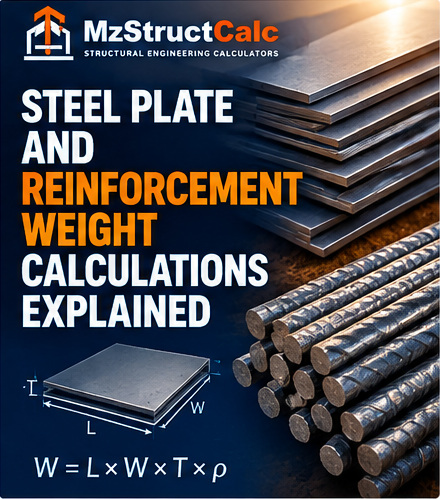
Mass equals volume multiplied by density. The arithmetic is straightforward, but unit consistency is essential: dimensions expressed in metres yield volume in cubic metres, and density in kg/m³ then yields mass in kilograms.
Steel plate worked example
For a plate 2 m long, 1 m wide and 10 mm thick, thickness is 0.010 m. At an assumed steel density of 7,850 kg/m³, mass = 2 × 1 × 0.010 × 7,850 = 157 kg. Actual material grades and fabricated details may change the result.
Rebar mass worked example
For round reinforcing steel of 12 mm diameter and total length 100 m, cross-sectional area is π × (0.012 m)²/4. Using 7,850 kg/m³ gives approximately 88.78 kg. This excludes laps, bends, hooks, cutting waste and any special detailing.
Bar spacing and quantities
A spacing-based bar count must consider clear cover, edge offsets and whether the specified spacing is maximum or nominal. The simplified count floor(width/spacing)+1 may undercount bars when the remaining edge distance is unacceptable; verify bar layout from drawings.
Estimate materials with MzStructCalc
Explore the steel plate weight, rebar weight and reinforcement quantity tools in the MzStructCalc calculator directory, and verify every assumption before ordering materials.
**Explore the calculators:** Open the MzStructCalc structural calculators directory.
*Engineering note: These tools provide preliminary calculations, not code-compliant structural designs. Obtain independent professional verification before construction.*