
**SEO keyword:** beam deflection calculator
**Meta description:** Learn the simply supported beam deflection formula, unit conversions and limitations with a worked example.
What beam deflection means
Deflection is the vertical displacement of a beam under loading. It is a serviceability consideration, distinct from bending strength or shear resistance. Excessive movement may damage finishes or make a structure uncomfortable even when the beam is strong enough.
Simply supported beam under a uniform load
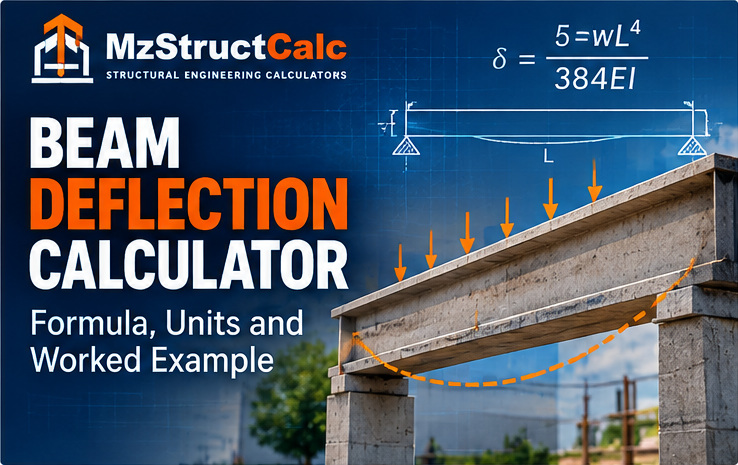
For a prismatic, linearly elastic beam supported at both ends and carrying a uniformly distributed load over the entire span, maximum deflection is δ = 5wL⁴/(384EI). Here w is force per length, L is span, E is elastic modulus and I is second moment of area. The equation assumes small deflections and constant stiffness.
Worked example
Consider w = 5 kN/m, L = 4 m, E = 200 GPa and I = 8,000 cm⁴. Convert w to 5,000 N/m, E to 200 × 10⁹ N/m² and I to 8 × 10⁻⁵ m⁴. The resulting maximum deflection is approximately 1.04 mm. This is a mathematical example, not an acceptance check.
What this calculation does not check
It does not establish the allowable deflection for a particular building use. It also excludes creep, cracking, shear deformation, variable stiffness, lateral instability, connection flexibility and other load cases. Check the governing design standards and serviceability criteria before making a design decision.
Try the preliminary beam tool
Use the MzStructCalc calculator directory to explore beam deflection, bending moment and support shear tools. Always verify the assumed supports and loading.
**Explore the calculators:** Open the MzStructCalc structural calculators directory.
*Engineering note: These tools provide preliminary calculations, not code-compliant structural designs. Obtain independent professional verification before construction.*